How Jewar International Airport Is Creating the Next Commercial Real Estate Boom in Delhi NCR
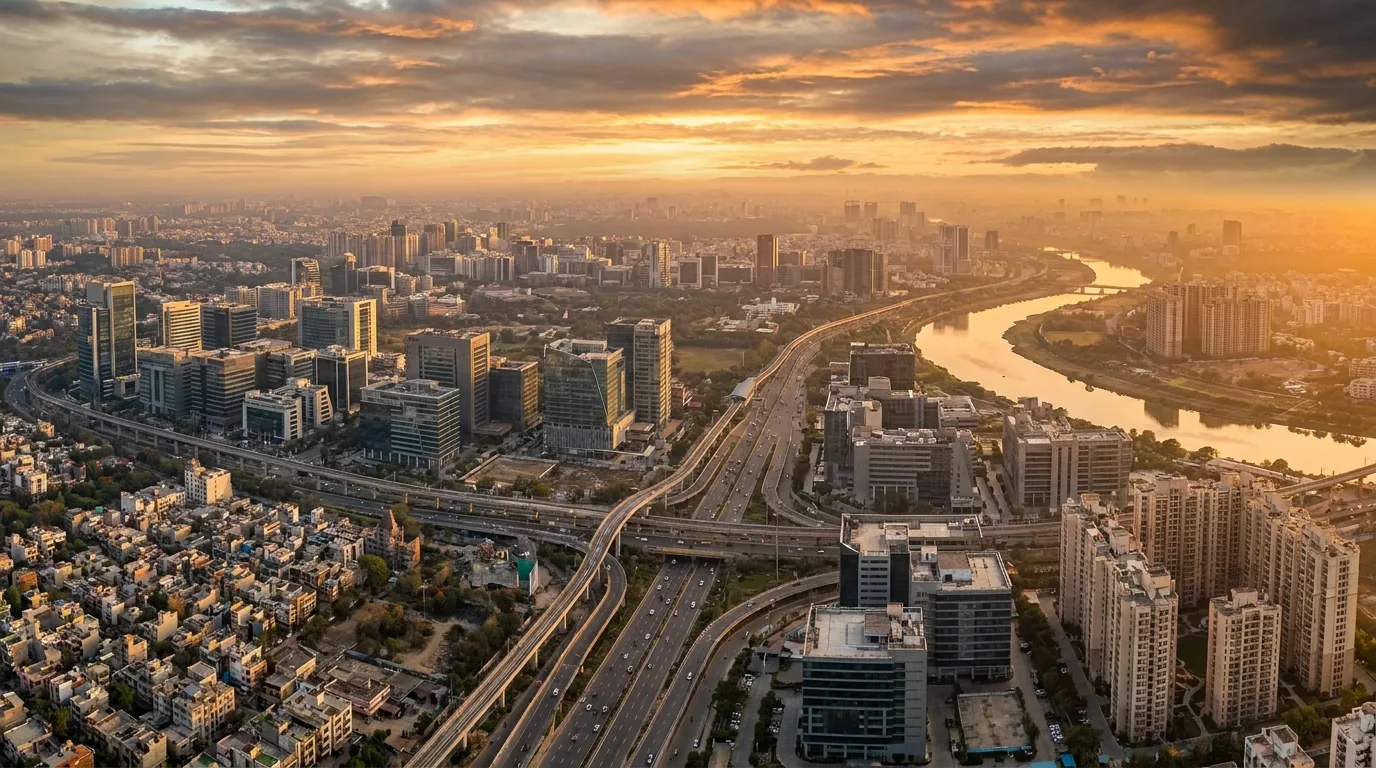
Noida International Airport at Jewar is transforming the Yamuna Expressway corridor into Delhi NCR's next major commercial real estate growth zone. With an eventual capacity exceeding 70 million passengers annually, YEIDA's structured development framework covering logistics parks, aerocity commercial zones, business parks, Hospitality developments and mixed-use projects is creating multiple distinct investment opportunities across the airport influence area. Commercial property near Jewar Airport currently offers early-stage entry prices with high appreciation potential, while established Noida corridors, including Sector 62, benefit from forward-looking demand uplift as airport operations approach. This is Delhi NCR's next commercial real estate boom, and it has already begun.
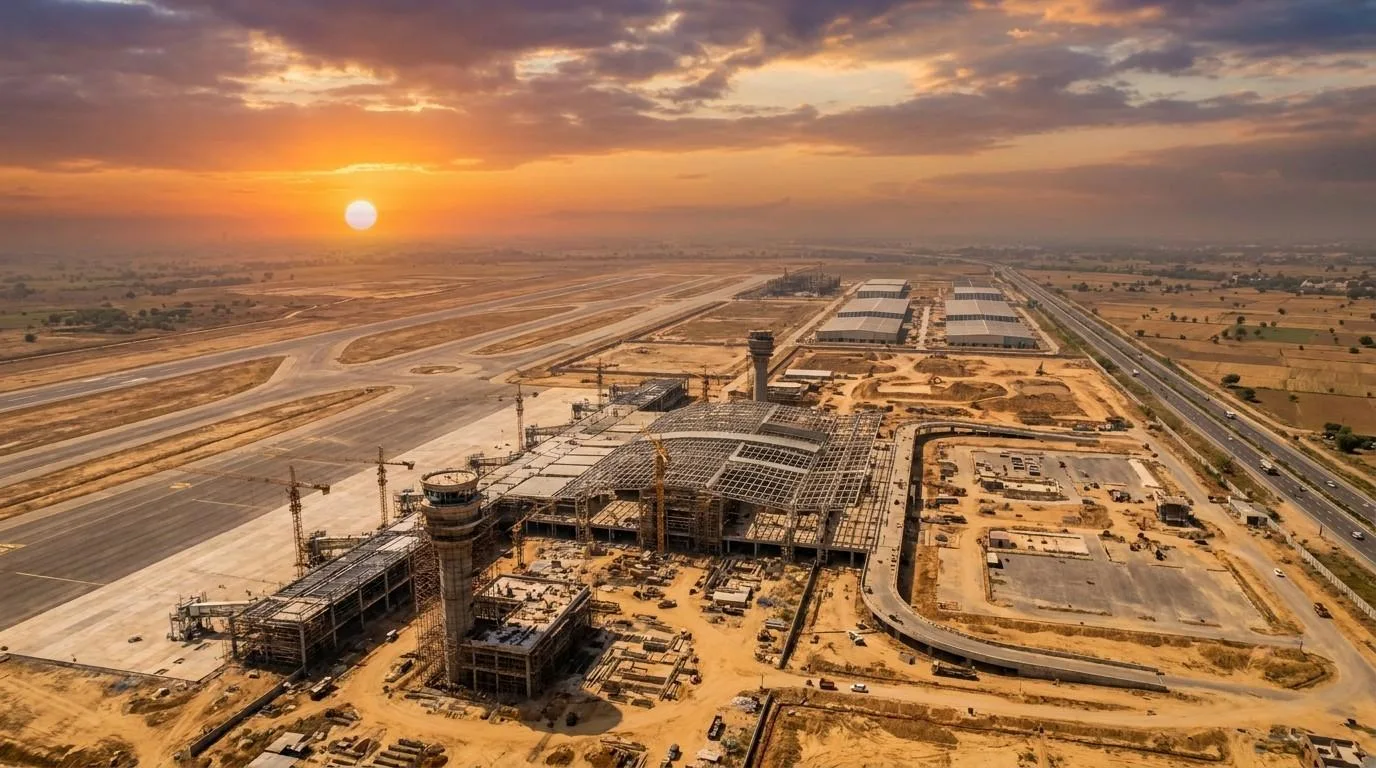
Something significant is happening along the Yamuna Expressway. Land that was an agricultural field a decade ago is transforming into one of India's most ambitious urban and commercial development zones. Construction cranes dot the horizon. Expressway lanes are expanding. YEIDA offices are processing thousands of land applications. And at the center of it all, Noida International Airport at Jewar is taking shape as the anchor that will define Delhi NCR's next commercial real estate cycle.
Commercial property near Jewar Airport is not a speculative play anymore. It is a structural investment opportunity backed by government commitment, institutional capital, corporate demand, and one of the largest aviation infrastructure investments in Indian history.
For investors tracking Jewar Airport investment opportunities, business owners evaluating their next location decision, and developers positioning for the region's next growth wave, understanding this corridor in depth is no longer optional. It is essential.
This article covers everything. The airport's scale and timeline; YEIDA's development framework; the commercial asset classes being created; the surrounding infrastructure; the investment case for different buyer profiles; how this corridor connects to the broader commercial property in the Noida market; and where specific opportunities exist right now.
This is Delhi NCR's next commercial real estate boom. Here is how to understand it and how to position yourself within it.
The Scale of What Is Being Built at Jewar
Before discussing commercial real estate, it helps to understand the sheer scale of what the Noida International Airport at Jewar represents.
This is not a regional airport with a handful of terminals and limited commercial catchment. It is being developed as one of Asia's largest aviation hubs.
Phase 1 targets an annual passenger capacity of approximately 12 million, with the first terminal expected to be operational by late 2025 or early 2026.
A full build-out across all planned phases will take annual passenger capacity to over 70 million, placing Noida International Airport in the same league as major global aviation hubs. At full capacity, it will be one of the five largest airports in India.
The Site Area spans approximately 5,000 acres dedicated to the airport itself, with thousands of additional acres surrounding it being developed by YEIDA for commercial, industrial, institutional, and residential purposes.
The investment in airport infrastructure alone runs into tens of thousands of crores. When surrounding commercial and urban development is included, the total capital formation in this corridor over the next decade will be among the largest concentrated in any single Indian geography.
For real estate investment in Delhi NCR, this is the single most important new infrastructure project since Delhi Metro's initial lines changed the city's property landscape two decades ago.
Why Airports Create Commercial Real Estate Booms
To understand why Jewar Airport investment opportunities are generating such significant interest, it helps to examine what happens to commercial real estate around major airports globally and in India.
The Aerotropolis Effect
Urban economists use the term "aerotropolis" to describe the city-like commercial development that forms around major international airports. The concept, popularized by Dr. John Kasarda, observes that just as cities historically grew around seaports and railway stations, modern economic activity increasingly clusters around airports.
Businesses that benefit most from proximity to airports, including logistics companies, freight forwarders, hospitality operators, aerospace manufacturers, business hotels, conference facilities, and companies with heavy international travel requirements, all seek locations within a 20 to 30 kilometer radius of major airports.
Indian Evidence
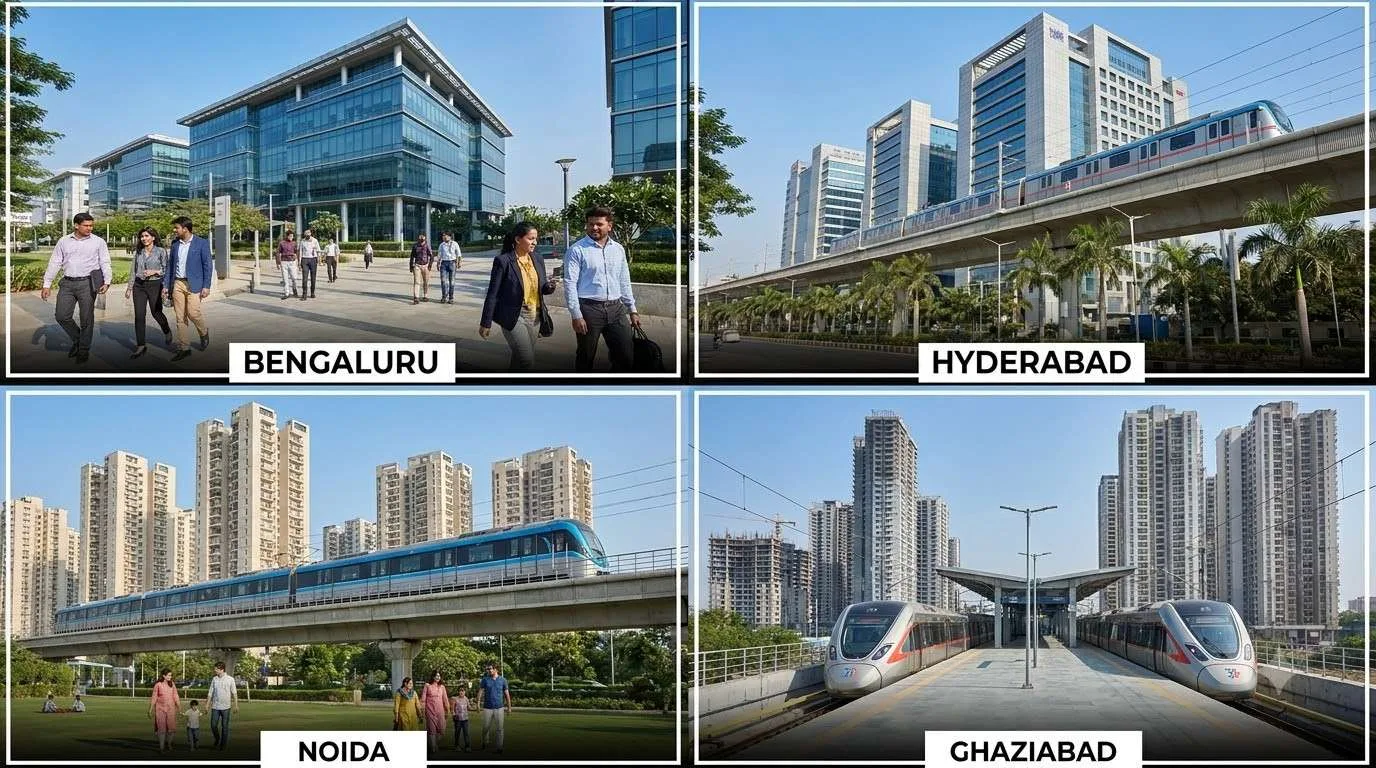
India's own airport development history supports this pattern clearly. The development around Indira Gandhi International Airport in Delhi transformed the Aerocity zone into one of the country's most valuable commercial real estate corridors within five years of operational maturity. Bengaluru's Kempegowda International Airport drove the transformation of Devanahalli from a small town to a major commercial and IT investment destination. Hyderabad's Rajiv Gandhi International Airport anchored the commercial development of the entire Shamshabad belt.
Jewar is following the same pattern, but at a scale that exceeds any of these precedents in the Indian context.
The Multiplier Effect
Every major airport job creates multiple supporting jobs in adjacent industries. Logistics workers, hospitality staff, retail workers, commercial office employees, and transport workers all need to be located near the airport. This creates residential demand, which drives retail, which drives mixed-use commercial development, which attracts more businesses, which generates more employment in a self-reinforcing cycle.
YEIDA's development planning is specifically designed to capture and direct this multiplier effect across the thousands of acres surrounding the airport.
YEIDA's Master Plan — The Framework Driving Commercial Development
The Yamuna Expressway Industrial Development Authority is the statutory body responsible for planning and developing the land surrounding the Noida International Airport. Understanding YEIDA's master plan is essential for any investor evaluating commercial land near Jewar Airport.
YEIDA's development framework divides the surrounding land into distinct use zones, each targeting a specific type of commercial, industrial, or urban activity.
Aerocity Zone
Immediately adjacent to the airport, the Aerocity zone is designated for aviation-linked commercial development. This includes business hotels, convention centers, airline offices, cargo handling facilities, and high-end retail. The Aerocity zone is the premium commercial belt where land values are highest and demand from aviation-dependent businesses is most concentrated.
Logistics and Warehousing Zone
A substantial land allocation is dedicated to logistics parks, warehousing facilities, cold chain infrastructure, and freight handling operations. The proximity to the airport, combined with access to the Yamuna Expressway and the Eastern Dedicated Freight Corridor, makes this zone exceptionally attractive for e-commerce logistics operators, FMCG companies, pharmaceutical distributors, and international freight handlers.
Industrial and Manufacturing Zone
YEIDA has designated significant acreage for manufacturing activities, particularly aerospace and aviation-linked manufacturing, electronics production, auto components, and precision engineering. This aligns with India's Make in India initiative and the government's desire to develop airport-adjacent manufacturing clusters similar to those around major Asian airports.
IT and Business Park Zone
Office parks and IT campuses are designated in zones with good road connectivity to the airport and to the broader Noida market. Technology companies, business services firms, and GCCs are being targeted for these zones as employers that benefit from airport proximity without needing to be immediately adjacent to the terminal.
Hospitality Zone
Hotels, serviced apartments, and hospitality facilities are designated in multiple zones around the airport. Business travelers, airline crew, and transit passengers create consistent base demand, while the convention and MICE facilities being planned will attract corporate event demand.
Mixed-Use Development Zone
Several zones are designated for mixed-use development combining commercial, residential, retail, and hospitality elements. These are designed to create self-contained urban nodes that reduce dependence on long commutes and create vibrant 24-hour environments around the airport.
Film City and Entertainment Zone
One of the more distinctive elements of YEIDA's plan is a dedicated Film City development, creating an entertainment industry cluster that adds a unique commercial demand generator to the corridor.
Commercial Asset Classes Being Created Near Jewar Airport
The development activity around Jewar Airport is creating multiple distinct commercial real estate asset classes, each with its own investment characteristics.
Logistics Parks and Warehousing
This is arguably the most immediately investable asset class in the Jewar corridor right now.
India's logistics sector is growing at 8% to 10% annually, driven by e-commerce expansion, manufacturing growth, and improving supply chain sophistication among Indian companies. Grade-A warehousing demand is significantly outpacing supply across the NCR, and Jewar's location offers the kind of multimodal connectivity that logistics operators prize most highly.
Why Jewar for logistics?
The Yamuna Expressway provides direct high-speed road access to Agra, connecting to the broader North India market. The Eastern Dedicated Freight Corridor passes through the greater Noida area, providing rail freight connectivity. The airport itself creates massive air freight demand, which is particularly relevant for time-sensitive and high-value cargo categories, including pharmaceuticals, electronics, and perishable goods. And land costs in the Jewar corridor are substantially lower than in established logistics hubs closer to Delhi, making large-scale warehouse development economically viable.
JLL India has identified the Yamuna Expressway corridor as one of India's top five emerging logistics real estate markets, with Grade-A warehousing demand expected to grow significantly as the airport becomes operational.
Business Parks and Office Campuses
The office market near Jewar Airport is in its earliest stages, but the development framework being laid by YEIDA is specifically designed to attract corporate occupiers.
Companies in sectors including aerospace, aviation services, logistics technology, travel and tourism, and international trade services have strong locational preferences for airport proximity. As Jewar becomes operational, these sectors will generate genuine demand for business park space in the surrounding zone.
Additionally, the cost differential between Jewar corridor office space and established NCR markets like Sector 62 Noida or Gurugram will attract companies that want a Delhi NCR address with lower real estate costs and direct airport access.
CBRE South Asia has noted that airport-adjacent business parks in India have consistently delivered above-average rental growth in the three to five years following airport opening, as demand from aviation-linked businesses transitions from speculative to operational.
Hospitality and Serviced Apartments
Airport hotels and serviced apartments are among the most predictable commercial real estate investments in an airport-led development zone.
Passenger volumes, airline crew rotations, and business traveler demand create a consistent base occupancy for hotel operators near major airports. As Jewar's passenger volumes grow from Phase 1's 12 million annually to full capacity, the hospitality demand profile will strengthen correspondingly.
International hotel operators, including multiple global chains, have already expressed interest in the Jewar aerocity zone, according to YEIDA's investor outreach programs. Early investors in hospitality assets here are positioning ahead of operational demand that will build progressively over the next five to seven years.
Convention and MICE Facilities
The Meetings, Incentives, Conferences, and Exhibitions sector is a significant demand generator for commercial real estate near major airports. Convention centers, exhibition halls, and purpose-built MICE facilities require large land parcels, direct airport access, and proximity to hotel inventory.
Jewar's development framework includes MICE-specific zones that could become the NCR's primary destination for large-scale corporate events and international conferences, complementing and potentially competing with Delhi's existing Pragati Maidan complex.
Retail and Mixed-Use Commercial
Airport-adjacent retail benefits from multiple demand streams simultaneously. Local resident catchment, business traveler spending, airport staff purchasing power, and tourism-linked retail all contribute to a retail environment that is more resilient than purely residential-dependent retail.
Mixed-use developments near Jewar that combine retail, office, and residential components are being designed to capture these multiple demand streams and create environments where people want to live, work, and spend, reducing the single-use development risk that affects many retail investments.
Infrastructure Connecting Jewar Airport to the Wider NCR
A major airport without supporting ground infrastructure is an island. What makes Jewar particularly compelling as a commercial real estate catalyst is the quality and breadth of ground infrastructure being developed around it.
Yamuna Expressway
The 165-kilometer six-lane Yamuna Expressway connects Jewar directly to Greater Noida and Noida and southward to Agra. It is the primary ground access route to the airport and the backbone of commercial development along the corridor. The expressway is being widened to eight lanes in sections, and elevated sections are planned to handle the increased traffic volumes that airport operations will generate.
Delhi-Mumbai Expressway
The Delhi-Mumbai Expressway passes through the southern Haryana and western UP belt, with connections that link to the Jewar corridor. This expressway opens Jewar-adjacent logistics and industrial development to markets across Rajasthan, Gujarat, and ultimately Mumbai.
Eastern Dedicated Freight Corridor
The Eastern DFC passes through the Greater Noida and Dadri area, creating a rail freight connection for the industrial zones near Jewar. For manufacturers and logistics operators requiring rail-based supply chain solutions, this connectivity is highly valuable.
Proposed Pod Taxi System
YEIDA has explored plans for a pod taxi or automated people mover system connecting the airport to surrounding commercial zones, improving last-mile connectivity within the aerocity development area.
Metro Connectivity
Plans for metro connectivity to Jewar Airport have been discussed at multiple levels of government. While the timeline for metro extension to Jewar remains to be confirmed, the broader Noida and Greater Noida metro network already provides connectivity to the northern end of the Yamuna Expressway corridor, and any metro extension toward Jewar would dramatically accelerate commercial development along its route.
RRTS Connectivity
Delhi-Agra RRTS corridor discussions include potential connectivity to Jewar Airport, which would provide high-speed rail access from central Delhi to the airport in under 30 minutes. If confirmed and built to the timeline, this would be transformational for commercial real estate values along the entire corridor.
How Jewar Airport Strengthens Commercial Property in Noida
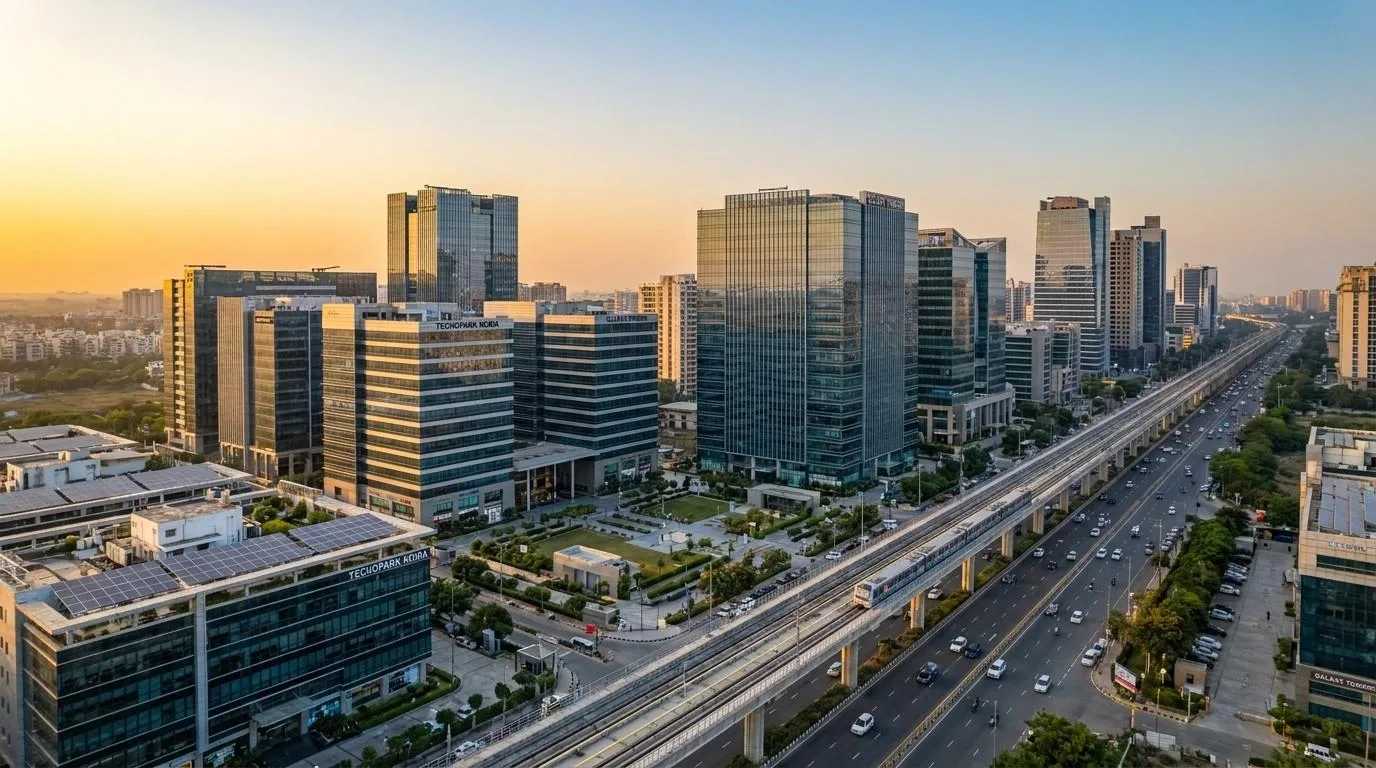
The Jewar Airport effect is not limited to the immediate airport zone. It radiates across the entire eastern NCR commercial market, including the established commercial property in Noida corridors that are already mature investment markets.
Sector 62 and the Noida Expressway Corridor
For companies with offices in Sector 62 or the Noida Expressway sectors, Jewar Airport will be accessible in 30 to 40 minutes via the Yamuna Expressway. This transforms Noida's established commercial corridors from regional business locations into globally connected business hubs. Companies with international operations that previously favored Gurugram for its proximity to IGI Airport now have a compelling reason to consider Noida, where real estate costs are lower and the upcoming airport will provide equivalent or better connectivity.
This is a direct uplift to demand in established Noida commercial corridors, supporting both rental growth and capital appreciation in projects like One Estate 62, Bhutani Cyber Park, and Maasters Capitol Avenue in Sector 62, Noida.
Greater Noida
Greater Noida sits between Noida and the Jewar corridor, positioning it to capture development pressure from both directions. As the Jewar zone develops and land prices there rise, commercial development will expand northward through Greater Noida, creating a continuous commercial belt from Sector 62 to Jewar over the coming decade.
The Yamuna Expressway Belt
Every sector and township along the 165-kilometer Yamuna Expressway corridor between Greater Noida and Jewar benefits from the airport's development. Land values along this corridor have already moved significantly since airport construction began, and they will continue to appreciate as operational reality approaches.
Investment Corridors Comparison Near Jewar Airport
| Zone | Distance from Airport | Primary Asset Class | Current Price PSF/Acre | Appreciation Outlook | Development Stage | Investor Profile |
|---|---|---|---|---|---|---|
| Aerocity Zone | 0–3 km | Hotel, Retail, Aviation Office | Premium — ₹15,000+ PSF | Very High | Early Active | HNI, Institutional |
| Logistics Zone | 3–10 km | Warehousing, Logistics Parks | ₹25–45 Cr per acre | High | Active Development | Institutional, Developer |
| IT Business Park Zone | 5–15 km | Office Campus, Business Park | ₹8,000–₹12,000 PSF | High | Early Stage | Corporate, HNI |
| Industrial Zone | 5–20 km | Manufacturing, Aerospace | ₹15–30 Cr per acre | High | Active | Industrial, Institutional |
| Hospitality Zone | 2–8 km | Hotels, Serviced Apartments | ₹10,000–₹16,000 PSF | Very High | Early Active | Hotel Operators, HNI |
| Mixed-Use Zone | 8–15 km | Retail, Residential, Office | ₹6,000–₹10,000 PSF | Very High | Early Stage | Developer, HNI |
| Greater Noida Sectors | 15–25 km | Office, Logistics, Retail | ₹5,000–₹9,000 PSF | High | Growth Phase | All Investor Types |
| Noida Expressway Sectors | 25–40 km | Grade-A Office, IT Parks | ₹7,000–₹14,000 PSF | Moderate-High | Mature | Income Investors |
Infrastructure Projects Powering the Jewar Commercial Boom
| Project | Status | Commercial Impact | Completion Timeline | Zone Benefiting |
|---|---|---|---|---|
| Noida International Airport Phase 1 | Under Active Construction | Primary demand catalyst, 12M pax capacity | 2025–2026 | All Jewar Zones |
| Yamuna Expressway Widening | In Progress | Improved access, increased traffic capacity | 2025 | Entire YE Corridor |
| Eastern Dedicated Freight Corridor | Operational | Rail freight access for industrial zones | Active | Industrial Zone |
| Delhi-Mumbai Expressway | Partially Operational | South-west NCR connectivity | 2025 Full | Southern Zones |
| YEIDA Sector Roads | Under Development | Internal zone connectivity | Rolling | All YEIDA Zones |
| Pod Taxi System | Planned | Last-mile airport connectivity | TBD | Aerocity Zone |
| Metro Extension to Jewar | Proposed-Planned | Transformational connectivity upgrade | 2028–2030 | All Zones |
| Delhi-Agra RRTS | Under Discussion | 30-min Delhi-Airport connectivity | TBD | Entire Corridor |
| Film City Development | YEIDA Approved | Entertainment industry cluster | 2026–2027 | Entertainment Zone |
| Noida Airport Cargo Terminal | Under Planning | Air freight hub creation | Phase 1 | Logistics Zone |
Connecting Jewar to Established Noida Commercial Projects
One of the most compelling aspects of the Jewar story for commercial investors is that you do not have to choose between established market stability and emerging market upside. The two are connected.
Investing in established commercial property in Noida corridors today gives you an asset that is already generating rental income in a proven market while also benefiting from the forward-looking demand uplift that Jewar Airport will bring to all established NCR commercial corridors.
For investors evaluating commercial property listings in Delhi NCR, the Sector 62 corridor in Noida represents this dual advantage most clearly.
One Estate 62 in Sector 62, Noida, is a Grade-A commercial development that already benefits from the sector's established corporate demand, metro connectivity, and expressway access. As Jewar Airport approaches operational status, the corridor's appeal to internationally oriented corporations will grow, supporting further rental and capital value appreciation. Explore office space for sale in Sector 62, Noida, at One Estate 62 for complete investment details.
Bhutani Cyber Park brings institutional developer quality to the same Sector 62 corridor. Companies choosing Noida for their India GCC operations will increasingly prioritize the city's Jewar Airport access as part of their location rationale, directly supporting demand for premium office space like Bhutani Cyber Park Commercial Property.
Maasters Capitol Avenue offers investors a competitively priced entry point into Sector 62 that captures both current rental income and the forward-looking appreciation that Jewar Airport will drive across Noida's established commercial corridors. Discover Maasters Capitol Avenue Office Space for pricing and specifications.
All three projects and the broader Jewar corridor opportunity are accessible through Property Guide Online, Delhi NCR's trusted platform for commercial property investment research and listings.
Who Should Invest in Commercial Property Near Jewar Airport?
Different investor profiles will find different aspects of the Jewar opportunity most aligned with their objectives.
Institutional Investors and Family Offices
Large-scale logistics park investments, industrial land acquisitions, and hospitality developments near Jewar are natural territory for institutional capital. The scale of land available, the long-term nature of airport-led demand, and the government's commitment to the project all align with institutional investment horizons and return requirements.
High-Net-Worth Individual Investors
HNIs can access the Jewar opportunity through commercial plot investments in YEIDA sectors, individual commercial units in emerging projects, or through established Noida commercial corridors that benefit from the airport's demand uplift. Entry points vary significantly based on zone and asset class.
Real Estate Developers
The Jewar corridor is one of India's most active developer markets right now. Mixed-use projects, business parks, hospitality developments, and logistics park developments are all active. Developers with experience in airport-adjacent development in other Indian cities are bringing that expertise to Jewar.
Corporate Owner-Occupiers
Companies in logistics, aviation services, aerospace, and international trade should seriously evaluate owning rather than leasing their Jewar corridor facilities. The appreciation trajectory of airport-adjacent commercial real estate in India supports ownership economics strongly.
NRI Investors
Non-resident Indians looking for high-growth India real estate exposure will find the Jewar corridor compelling. The combination of government-backed infrastructure, clear development frameworks, and strong appreciation potential makes this a well-structured investment opportunity even for investors managing their positions remotely.
Risks and Considerations for Jewar Corridor Investment
A balanced analysis requires acknowledging the risks alongside the opportunities.
Timeline Risk
Large infrastructure projects in India have historically faced delays. While Jewar Airport's construction is progressing and Phase 1 timelines appear on track, investors should plan for scenario flexibility around exact operational dates.
Liquidity Risk
The Jewar corridor is an emerging market. Secondary market liquidity for commercial assets here is significantly lower than in established Noida or Gurugram corridors. Investors should plan for a medium to long holding period of five to ten years minimum.
Regulatory Risk
Land acquisition and development in YEIDA zones involves regulatory processes that can be complex. Working with verified developers and platforms like Property Guide Online that focus on due-diligence-backed listings reduces this risk.
Demand Ramp-Up Risk
Airport-led commercial development typically takes three to five years after opening to see full demand ramp-up. Early investors benefit most from appreciation but should not expect immediate income yields comparable to established markets.
Infrastructure Sequencing Risk
Some supporting infrastructure, including metro connectivity and RRTS, has not yet been confirmed or funded. Delays to these projects could affect the pace of commercial demand ramp-up in certain zones.
Understanding these risks clearly allows investors to size their Jewar exposure appropriately relative to their portfolio and to balance it with positions in more established markets where income is current and predictable.
Expert Insights on Jewar Airport's Commercial Real Estate Impact
JLL India has published analysis suggesting that Jewar Airport could generate commercial real estate demand of over 50 million square feet across logistics, office, hospitality, and retail asset classes in the surrounding zone over a fifteen-year development horizon.
Knight Frank India identified the Yamuna Expressway corridor as one of India's top three emerging real estate investment destinations in its most recent market outlook, citing the airport catalyst as the primary demand driver.
CBRE South Asia has compared Jewar's potential development impact to that of Bengaluru's Devanahalli corridor, which saw commercial real estate values increase by over 200% in the decade following Kempegowda Airport's opening.
Cushman & Wakefield noted that logistics real estate demand in the Jewar zone is already active ahead of airport operations, driven by the corridor's expressway connectivity and lower land costs relative to established NCR logistics hubs.
YEIDA itself has reported receiving expressions of interest from over 200 domestic and international companies across logistics, hospitality, aerospace, and technology sectors for various development zones in the airport influence area.
Invest India has highlighted the Jewar corridor as a priority destination for foreign direct investment in manufacturing, logistics, and aviation services, with dedicated investment facilitation resources assigned to the zone.
CREDAI's NCR chapter has flagged the Yamuna Expressway belt as one of the top three emerging real estate micro-markets in northern India, with particular attention to the commercial development opportunities being created by YEIDA's systematic land development framework.
People Also Ask
What commercial real estate opportunities exist near Jewar Airport?
Commercial real estate near Jewar Airport includes logistics parks, warehousing facilities, business parks, IT office campuses, airport hotels, serviced apartments, convention centers, mixed-use developments, aerospace manufacturing facilities, and retail commercial zones. YEIDA's master plan designates specific zones for each asset class, providing a structured framework for investment across multiple commercial real estate categories.
How will Jewar Airport affect commercial property prices in Noida?
Jewar Airport will elevate commercial property values across the entire eastern NCR, including established Noida corridors. Companies with international operations will increasingly favor Noida locations for their 30 to 40 minute airport access. This creates additional demand for Grade-A office space in corridors like Sector 62, supporting rental growth and capital appreciation on top of existing demand fundamentals.
What is YEIDA, and what role does it play in Jewar development?
YEIDA, the Yamuna Expressway Industrial Development Authority, is the statutory planning and development body for the land surrounding Noida International Airport at Jewar. It designates land use zones, acquires and develops land, builds infrastructure, and facilitates investment across logistics, commercial, industrial, hospitality, and mixed-use development categories in the airport influence area.
Is now a good time to invest in commercial property near Jewar Airport?
Yes, for investors with medium to long horizons. The airport is in active construction, with Phase 1 targeted for 2025 to 2026. Commercial development is in early stages, meaning entry prices reflect current conditions rather than fully realized airport demand. Historical precedent from Bengaluru and Hyderabad airports suggests that investors who enter before operational maturity capture the strongest appreciation returns.
How does Jewar Airport compare to other airport-led commercial real estate developments in India?
Jewar Airport's eventual capacity of over 70 million passengers annually exceeds the current scale of Bengaluru and Hyderabad airports, which have each generated substantial commercial real estate development in their surrounding zones. YEIDA's systematic land development framework also provides more structured investment clarity than was available in some earlier Indian airport development zones, reducing speculative uncertainty for investors.
Conclusion: The Jewar Boom Is Not Coming. It Has Already Begun.
The most common mistake investors make with transformational infrastructure projects is waiting for the transformation to be fully visible before acting. By that point, the best entry prices are history, and the early movers have already captured the most significant returns.
Jewar Airport's commercial real estate boom is not a future event. It is a current process. Land is being developed. Companies are evaluating locations. Infrastructure is being built. YEIDA schemes are being launched. Developers are acquiring land and planning projects. The trajectory is clear, the government commitment is unambiguous, and the scale of what is being created will reshape Delhi NCR's commercial geography for the next thirty years.
For investors who want to participate in the Jewar story directly, the logistics, hospitality, and mixed-use zones being developed by YEIDA represent the highest-appreciation-potential commercial real estate in the NCR today. The trade-off is patience and liquidity tolerance over a medium to long investment horizon.
For investors who want the Jewar upside combined with current income and proven demand, the established commercial properties in Noida corridors offer the best of both worlds. Projects like One Estate 62, Bhutani Cyber Park, and Maasters Capitol Avenue in Sector 62 Noida are generating rental income today while also positioned to benefit from the demand uplift that Jewar Airport will deliver to all established NCR commercial corridors.
The airport is being built. The commercial ecosystem around it is taking shape. The question is not whether the Jewar boom will happen. The question is whether you will be positioned within it when it does.
Begin your research with full confidence through Property Guide Online, your trusted guide to commercial real estate investment across Noida, the Jewar corridor, and the wider Delhi NCR market.
This article is based on publicly available information, government announcements, YEIDA development plans, and market research from leading real estate consultancies. All investment decisions should be made after independent due diligence, legal verification, and professional financial advice.