
Hyderabad vs Bengaluru vs Noida: Which City Offers Better Property Returns?
Compare Hyderabad, Bengaluru, and Noida for property investment. Explore rental yields, price growth, infrastructure, risks, and ROI to find the best city for your goals.
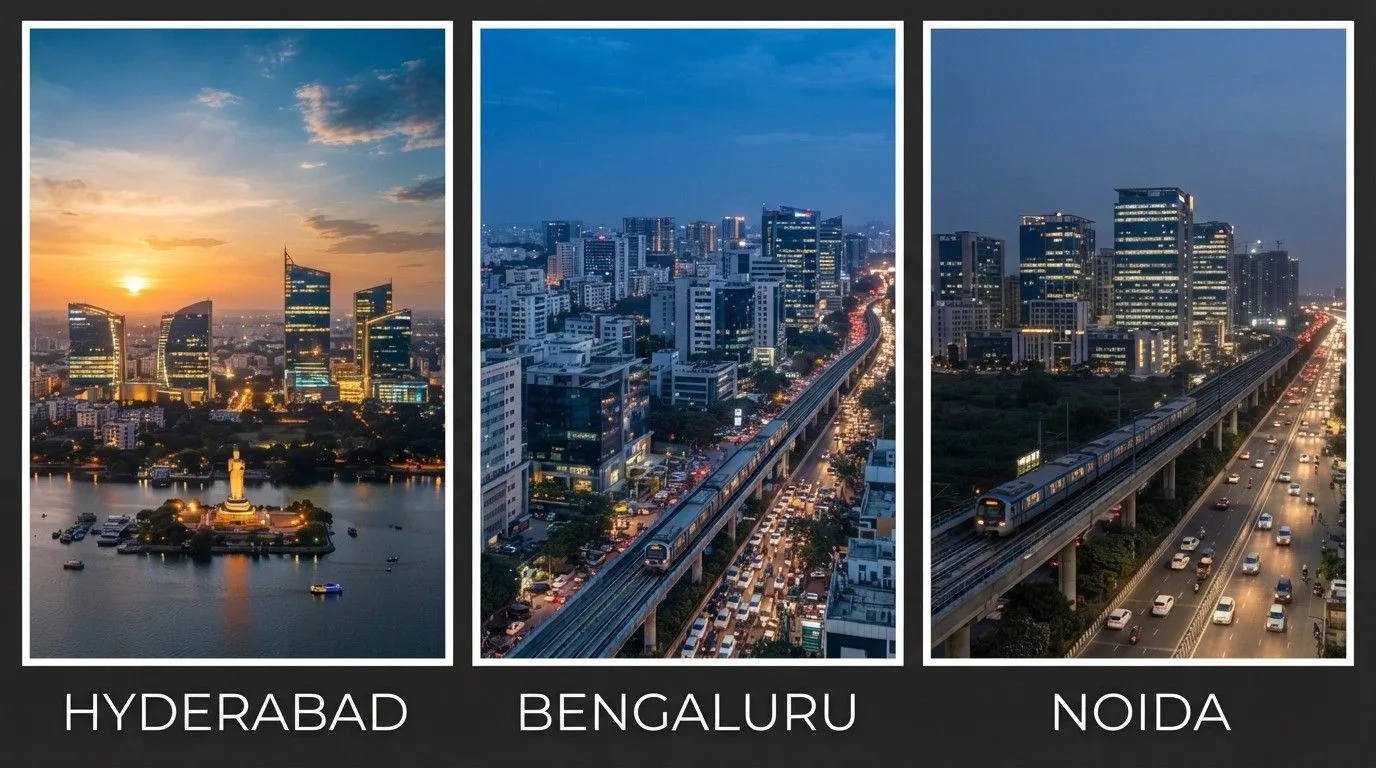
The question every serious real estate investor asks at some point is not which property to buy, but which city to buy in. For investors evaluating opportunities across India's major metro markets, three cities consistently dominate the conversation: Hyderabad, Bengaluru, and Noida. Each has emerged as a powerhouse in its own right, driven by different economic engines, infrastructure profiles, and growth trajectories.
But when it comes to the best city for property investment in India, the answer is not universal. It depends on what you are optimizing for, rental yield, capital appreciation, entry price, exit liquidity, or risk-adjusted returns. Understanding how these three cities compare across every metric that matters is the foundation of making the right allocation decision.
This is the definitive comparison. We analyze residential and commercial property returns, infrastructure quality, economic fundamentals, price trends, rental yields, appreciation trajectories, regulatory environments, and specific investment-grade opportunities across all three cities. Whether you are a domestic investor building a multi-city portfolio, an NRI evaluating India exposure, or an institutional player allocating capital across Tier-1 markets, this guide provides the framework you need.
Let's break down Hyderabad, Bengaluru, and Noida city by city, metric by metric.
Why These Three Cities Dominate Indian Property Investment Conversations
Before diving into comparisons, understanding why Hyderabad, Bengaluru, and Noida occupy the top tier of India's real estate investment landscape helps frame the discussion.
Bengaluru is India's technology capital. It hosts the largest concentration of IT companies, startups, Global Capability Centers, and venture capital activity in the country. Its economic base is diversified across software services, product development, biotechnology, aerospace, and deep tech. This creates sustained employment growth that translates directly into real estate demand.
Hyderabad has emerged as Bengaluru's strongest competitor for technology investment while maintaining lower real estate costs. The city offers favorable state government policies, excellent physical and digital infrastructure, and a business environment that has attracted major global technology firms including Amazon, Google, Microsoft, and Apple. Its real estate market combines growth potential with relative affordability.
Nofirms,epresents the National Capital Region's eastern commercial and residential powerhouse. It benefits from proximity to Delhi's political and economic gravity, world-class metro connectivity, multiple expressway corridors, and the upcoming Noida International Airport at Jewar. Its real estate market serves both NCR's internal demand and corporations seeking Delhi market access without Delhi price points.
Together, these three cities account for a disproportionate share of India's GDP growth, technology employment, corporate real estate absorption, and real estate investment transaction volume.
Economic Fundamentals: The Foundation of Property Demand
Real estate returns are ultimately driven by economic activity. Cities with stronger job creation, higher wage growth, and more diversified economic bases tend to support better long-term property returns.
Bengaluru's Economic Profile
GDP: Approximately $110 billion, making it India's fourth-largest urban economy
Key Sectors: IT/ITES, biotechnology, aerospace, startups, electronics manufacturing
Major Employers: Infosys, Wipro, TCS, Cognizant, Amazon, Google, Microsoft, Walmart Labs
Employment Growth: 7-9% annually in technology sectors
Startup Ecosystem: India's startup capital with highest unicorn concentration
Economic Strength: Most diversified tech economy, deep talent pool, global connectivity
Economic Weakness: Infrastructure strain, traffic congestion, water resource constraints
Hyderabad's Economic Profile
GDP: Approximately $75 billion, growing rapidly
Key Sectors: IT/ITES, pharmaceuticals, biotechnology, data centers, aerospace
Major Employers: TCS, Tech Mahindra, Google, Amazon, Microsoft, Apple, ICICI, DBS
Employment Growth: 8-10% annually, fastest among major metros
Government Policy: Telangana state government highly proactive on investment attraction
Economic Strength: Strong policy support, lower costs, excellent infrastructure
Economic Weakness: Smaller economic base than Bengaluru or Delhi NCR, less diversified
Noida's Economic Profile
GDP: Part of Delhi NCR's $200+ billion economy
Key Sectors: IT/ITES, media, manufacturing, logistics, financial services
Major Employers: HCL, Adobe, Samsung, Wipro, Airtel, Paytm, Coforge
Employment Growth: 6-8% annually
NCR Advantage: Access to Delhi's central government, diplomatic, and financial sectors
Economic Strength: NCR market access, Jewar Airport catalyst, diversified beyond tech
Economic Weakness: Less concentrated tech ecosystem than Bengaluru or Hyderabad
Winner on Economic Fundamentals: Bengaluru edges ahead for technology concentration, but Hyderabad shows stronger current growth momentum. Noida benefits from NCR's larger overall economic mass but with less tech density.
Infrastructure Quality: Connectivity Drives Property Value
Infrastructure quality directly impacts property values by affecting commute times, accessibility, and quality of life for residents and workers.
Bengaluru Infrastructure
Metro: Namma Metro operational with 76 km across 2 lines, Phase 3 expanding to 175 km
Airport: Kempegowda International Airport, 40 km from city center, 60-90 min travel
Road Infrastructure: Congested inner city, improving outer ring road and expressways
IT Corridors: ORR, Whitefield, Electronic City, Manyata Tech Park well-established
Overall Assessment: Metro improving but still insufficient for city size; traffic remains major challenge
Hyderabad Infrastructure
Metro: Hyderabad Metro operational with 72 km, among India's largest operational networks
Airport: Rajiv Gandhi International Airport, 22 km from city center, 30-45 min travel
Road Infrastructure: Excellent road quality, ORR well-maintained, less congested than Bengaluru
IT Corridors: HITEC City, Gachibowli, Nanakramguda, Madhapur excellently connected
Overall Assessment: Best overall infrastructure among the three cities currently
Noida Infrastructure
Metro: Delhi Metro Blue and Aqua Lines operational, extensive NCR network
Airport: IGI Airport 30-40 min, Jewar Airport under construction (game-changer)
Road Infrastructure: Expressway network excellent (Noida, Yamuna, DND, FNG)
RRTS: Delhi-Meerut RRTS operational, additional corridors planned
IT Corridors: Sector 62, Expressway sectors extremely well-connected by metro and road
Overall Assessment: Best metro connectivity, Jewar Airport will be transformational
Winner on Infrastructure: Noida currently leads on metro connectivity and upcoming airport infrastructure. Hyderabad has the best current overall quality. Bengaluru is improving but still challenged.
Residential Property: Price Trends and Appreciation
Comparing residential property appreciation helps investors understand capital growth potential across cities.
Bengaluru Residential Market
Average Price Range: ₹4,500-₹12,000 per sq ft depending on locality
Premium Localities: Whitefield, Sarjapur Road, Electronic City, Hebbal (₹8,000-₹12,000)
Mid-Tier Localities: Marathahalli, KR Puram, Yelahanka (₹5,000-₹7,500)
5-Year Appreciation: 30-45% in prime localities
Price Growth Trend: Moderate but steady, slowing from earlier highs
Supply Situation: High inventory in some micro-markets; absorption improving
Hyderabad Residential Market
Average Price Range: ₹3,500-₹8,000 per sq ft depending on locality
Premium Localities: Gachibowli, Kokapet, Nanakramguda, Jubilee Hills (₹6,000-₹8,000)
Mid-Tier Localities: Miyapur, Kompally, Uppal (₹3,500-₹5,500)
5-Year Appreciation: 40-60% in prime IT corridors
Price Growth Trend: Strongest momentum among the three cities
Supply Situation: Well-balanced, healthy absorption
Noida Residential Market
Average Price Range: ₹3,500-₹9,000 per sq ft depending on locality
Premium Localities: Sector 62, 150, Greater Noida West premium (₹5,500-₹9,000)
Mid-Tier Localities: Sectors 75-78, 137, Greater Noida (₹3,500-₹5,500)
5-Year Appreciation: 25-40% in established sectors, higher in Jewar corridor
Price Growth Trend: Moderate in established areas, accelerating near Jewar
Supply Situation: Well-supplied, strong end-user demand
Winner on Residential Appreciation: Hyderabad shows the strongest recent appreciation. Bengaluru offers stability. Noida offers value entry with Jewar upside.
Commercial Property: Office Space Returns and Yields
Commercial property, particularly Grade-A office space, is where institutional capital concentrates and where yield-focused investors find the most compelling opportunities.
Bengaluru Commercial Market
Office Space Price: ₹8,000-₹16,000 per sq ft in prime IT corridors
Rental Yield: 6-8% per annum
Rental Rates: ₹60-₹120 per sq ft per month
Vacancy Rate: 12-15% in prime corridors (higher than historical average)
Absorption: 14-16 million sq ft annually (largest in India)
Occupier Profile: Global technology firms, GCCs, startups
Investment Case: Highest absolute demand but also highest supply and vacancy
Hyderabad Commercial Market
Office Space Price: ₹6,500-₹12,000 per sq ft in prime IT corridors
Rental Yield: 7-9% per annum
Rental Rates: ₹45-₹85 per sq ft per month
Vacancy Rate: 8-10% in prime corridors (healthy, tight market)
Absorption: 8-10 million sq ft annually (strong and growing)
Occupier Profile: Technology firms, GCCs, financial services
Investment Case: Best yield-to-price ratio among the three cities
Noida Commercial Market
Office Space Price: ₹7,000-₹14,000 per sq ft in prime corridors (Sector 62)
Rental Yield: 7-9% per annum
Rental Rates: ₹50-₹90 per sq ft per month
Vacancy Rate: 8-12% in prime corridors
Absorption: 4-5 million sq ft annually (growing post-Jewar announcement)
Occupier Profile: IT firms, GCCs, media, financial services
Investment Case: Strong yields with Jewar Airport providing forward catalyst
Featured Noida Commercial Opportunities:
One Estate 62 in Sector 62, Noida, offers Grade-A office space in NCR's premier IT corridor with metro connectivity and competitive entry pricing relative to Bengaluru and Hyderabad equivalents.
Bhutani Cyber Park delivers institutional-quality commercial development targeting technology and GCC occupiers in Noida's most established commercial corridor.
Maasters Capitol Avenue provides value-entry positioning in Sector 62, preserving appreciation upside as Jewar Airport approaches operational status.
Explore all opportunities at Property Guide Online.
Winner on Commercial Yields: Hyderabad and Noida offer superior rental yields (7-9%) compared to Bengaluru (6-8%). Hyderabad has the tightest vacancy. Noida has the strongest infrastructure catalyst ahead.
City-by-City Investment Comparison Table
| Metric | Bengaluru | Hyderabad | Noida (NCR) |
|---|---|---|---|
| Economic Base | $110B GDP | $75B GDP | Part of $200B+ NCR |
| Residential Price Range | ₹4,500-₹12,000 PSF | ₹3,500-₹8,000 PSF | ₹3,500-₹9,000 PSF |
| Commercial Price Range | ₹8,000-₹16,000 PSF | ₹6,500-₹12,000 PSF | ₹7,000-₹14,000 PSF |
| Rental Yield (Commercial) | 6-8% | 7-9% | 7-9% |
| 5-Yr Residential Appreciation | 30-45% | 40-60% | 25-40% (higher near Jewar) |
| Infrastructure Quality | Improving, Traffic Challenge | Excellent | Excellent, Best Metro |
| Airport Connectivity | 40 km, 60-90 min | 22 km, 30-45 min | 30-40 min IGI, Jewar, upcoming |
| Metro Coverage | 76 km, Expanding | 72 km, Operational | 390+ km NCR-wide network |
| Vacancy Rate (Office) | 12-15% | 8-10% | 8-12% |
| Annual Office Absorption | 14-16M sq ft | 8-10M sq ft | 4-5M sq ft |
| Entry Price Advantage | Low (Highest Prices) | High (Best Value) | Medium (Moderate Prices) |
| Liquidity (Exit Ease) | Very High | High | High |
| Tax Environment | Karnataka State | Telangana State | Uttar Pradesh/NCR |
| Regulatory Environment | RERA Mature | RERA Strong | RERA Improving |
| Best For | Established tech exposure | Yield + growth balance | NCR access + Jewar upside |
Rental Yield Analysis, Income vs Capital Growth
Different cities offer different trade-offs between current rental income and long-term capital appreciation.
Bengaluru currently offers the lowest rental yields (6-8%) among the three cities due to higher entry prices. However, it offers the most liquid resale market and the most established corporate occupier base, providing income stability at the cost of lower yield percentage.
Hyderabad delivers the best yield-to-price ratio with commercial rental yields of 7-9% and significantly lower entry prices than Bengaluru for equivalent-quality buildings. For income-focused investors, Hyderabad currently offers the most compelling risk-adjusted yield opportunity.
Noida matches Hyderabad's yield range (7-9%) while offering NCR market access and the forward-looking Jewar Airport catalyst. Investors here capture current income comparable to Hyderabad with the added benefit of NCR's larger economic mass and upcoming infrastructure that could drive rental growth acceleration.
Infrastructure Catalysts: What's Coming and When
Future infrastructure projects create forward-looking investment opportunities by changing accessibility and demand dynamics before they are fully priced into property values.
Bengaluru's Pipeline
- Namma Metro Phase 3: 175 km network by 2027-28
- Peripheral Ring Road: 116 km outer ring road planned
- Satellite Town Ring Road: Connecting peripheral townships
- Bengaluru-Chennai Expressway: High-speed connectivity to Tamil Nadu
Impact: Will significantly improve intra-city connectivity and reduce congestion pain points, supporting continued demand in outer corridors.
Hyderabad's Pipeline
- Hyderabad Metro Phase 2: Extension to airport and peripheral areas
- Regional Ring Road: 340 km outer ring road under construction
- Pharma City Development: Major pharmaceutical manufacturing cluster
- Data Center Hub Expansion: Significant data center investments ongoing
Impact: Will reinforce Hyderabad's infrastructure advantage and support expansion of IT corridors into peripheral zones.
Noida's Pipeline
- Noida International Airport Jewar: Phase 1 operational 2025–26
- Delhi Metro Phase 4: Additional NCR connectivity
- RRTS Network Expansion: Multiple rapid rail corridors
- Greater Noida West Metro: Connectivity to emerging zones
- Delhi-Mumbai Expressway: Regional logistics connectivity
Impact: Jewar Airport is the single most transformational infrastructure project among all three cities, with the potential to reshape the entire eastern NCR property landscape.
Winner on Future Infrastructure: Noida's Jewar Airport is the most significant catalyst. Hyderabad's RRR supports balanced growth. Bengaluru's metro expansion addresses existing constraints.
Investment Risk Analysis: What Could Go Wrong
No investment is risk-free. Understanding the specific risk profile of each city helps investors make informed allocation decisions.
Bengaluru Risks
- Infrastructure Saturation: Traffic congestion could worsen before improving
- Water Scarcity: Long-term water availability remains a structural concern
- High Inventory: Some micro-markets have oversupply, affecting absorption
- Price Ceiling: Already high prices may limit further appreciation runway
Hyderabad Risks
- Economic Concentration: Heavily dependent on IT sector, less diversified
- Smaller Market Size: Less absolute liquidity than Bengaluru or NCR
- Political Risk: State government policy changes could affect business climate
- Competition from Bengaluru: Will always be compared to and compete with its larger neighbor.
Noida Risks
- Timeline Risk: Jewar Airport construction and operational timelines could extend
- Regulatory Complexity: NCR spans multiple states; regulatory coordination can be complex
- Relative Tech Density: Lower tech company concentration than Bengaluru or Hyderabad
- Peripheral Liquidity: Some emerging corridors have lower secondary market liquidity
Tax and Regulatory Environment Comparison
Tax treatment and regulatory clarity affect net returns significantly for property investors.
RERA Implementation
All three states have implemented RERA, but maturity varies. Karnataka (Bengaluru) has the most mature RERA ecosystem. Telangana (Hyderabad) has shown strong enforcement. Uttar Pradesh (Noida) has been improving RERA processes, particularly through the Noida Authority's professionalization.
Stamp Duty
- Karnataka (Bengaluru): 5% (male), 5% (female), 3% (joint) - among India's most investor-friendly
- Telangana (Hyderabad): 5% (male), 5% (female), 3% (joint) - competitive with Karnataka
- Uttar Pradesh (Noida): 7% (male), 6% (female)—higher than southern states but recent reductions improved competitiveness
Registration Charges
- Karnataka: 1%
- Telangana: 0.5-1%
- Uttar Pradesh: 1%
Capital Gains Tax
Uniform across all cities under central government tax law. Long-term capital gains after 24 months of holding qualify for indexation benefits.
Winner on Tax Environment: Bengaluru and Hyderabad offer marginally better stamp duty rates. All three cities have adequate RERA implementation for institutional-grade investments.
For Different Investor Profiles: Which City Makes Sense?
Different investor types should prioritize different cities based on their specific objectives.
Income-Focused Investors (Rental Yield Priority)
Best Choice: Hyderabad or Noida
Commercial properties in both cities deliver 7-9% yields with lower entry prices than Bengaluru. Hyderabad offers slightly tighter vacancy. Noida offers NCR market depth.
Growth-Focused Investors (Capital Appreciation Priority)
Best Choice: Hyderabad or Noida (Jewar corridor)
Hyderabad shows the strongest recent appreciation momentum. Noida's Jewar corridor offers the highest appreciation runway but requires longer holding periods.
Liquidity-Focused Investors (Exit Flexibility Priority)
Best Choice: Bengaluru
Deepest secondary market, highest institutional investor interest, most developed resale ecosystem. Easier to exit positions at scale.
Value Investors (Entry Price Priority)
Best Choice: Hyderabad
Best price-to-quality ratio among the three cities. Entry prices 20-40% below Bengaluru for comparable Grade-A assets.
Balanced Investors (Yield + Growth + Risk Balance)
Best Choice: Noida
Offers 7-9% yields comparable to Hyderabad, forward infrastructure catalyst from Jewar, NCR market depth for liquidity, and moderate entry prices. Best risk-adjusted profile for balanced portfolios.
NRI Investors (Geographic Diversification)
All Three Cities: NRIs should consider multi-city exposure rather than concentration. Bengaluru for tech exposure, Hyderabad for yield, and Noida for NCR access and infrastructure upside.
Expert Insights from Leading Consultancies
JLL India in its 2023 India Real Estate Review identified Bengaluru, Hyderabad, and NCR (including Noida) as the top three markets for Grade-A office absorption, collectively accounting for over 70% of India's total commercial real estate demand.
Knight Frank India highlighted in its India Real Estate Market Outlook that Hyderabad delivered the strongest price appreciation among major cities in 2023, while Bengaluru absorbed the highest absolute square footage, and NCR benefited from the most diverse sectoral demand base.
CBRE South Asia noted that commercial rental yields in Hyderabad and Noida (7-9%) significantly outperform Bengaluru (6-8%) on a risk-adjusted basis, making both cities compelling for institutional capital seeking income generation.
Cushman & Wakefield identified the Noida International Airport at Jewar as one of the three most significant infrastructure catalysts for Indian real estate over the next decade, alongside Navi Mumbai Airport and Bengaluru Metro Phase 3.
CREDAI data shows that Hyderabad had the fastest project completion rates among the three cities in 2023, reflecting strong developer execution capabilities and lower construction delays.
Anarock Property Consultants' research indicates that Bengaluru continues to attract the highest share of startup and venture capital activity, supporting sustained residential rental demand from young, mobile professionals.
Final Investment Recommendation Framework
Use this decision framework to determine your allocation:
Step 1: Define Your Primary Objective
- Rental income generation → Hyderabad or Noida
- Capital appreciation → Hyderabad (current) or Noida Jewar corridor (forward)
- Exit liquidity → Bengaluru
- Balanced returns → Noida
Step 2: Assess Your Capital Availability
- Budget-conscious (₹1-2 crore) → Hyderabad or Noida
- Premium allocation (₹3-5 crore+) → Bengaluru or Noida Sector 62
- Institutional scale (₹10 crore+) → All three cities accessible
Step 3: Determine Your Holding Period
- Short horizon (3-5 years) → Bengaluru or Hyderabad
- Medium horizon (5-7 years) → Hyderabad or Noida established corridors
- Long horizon (7-10 years) → Noida Jewar corridor or Bengaluru Metro expansion zones
Step 4: Evaluate Your Risk Tolerance
- Risk-averse → Bengaluru established corridors
- Moderate risk → Hyderabad IT corridors or Noida Sector 62
- Higher risk appetite → Noida Jewar corridor or Bengaluru peripheral zones
Step 5: Consider Geographic Diversification
- Multi-city portfolios reduce risk and capture different economic cycles
- Allocate across cities rather than concentrating in one market
For Noida-specific opportunities, start your research at Property Guide Online, where verified commercial listings including One Estate 62, Bhutani Cyber Park, and Maasters Capitol Avenue provide institutional-grade entry points into NCR's premier commercial corridor.
This article is based on publicly available market research, government data, and insights from leading real estate consultancies, including JLL India, Knight Frank, CBRE, Cushman & Wakefield, Anarock, and CREDAI. All investment decisions should be made after independent due diligence, site visits, and professional financial and legal advice.