
AI Supercomputing Comes to Delhi: What the Param Pragya Facility at IIT Delhi Means for the City's Tech and Property Market
Param Pragya AI at IIT Delhi could shape Delhi NCR’s technology and real estate market over the next 5 to 10 years. This analysis compares Delhi’s AI infrastructure with technology-led growth in Bengaluru, Hyderabad, and Noida to assess potential office demand, commercial supply, and long-term property opportunities.
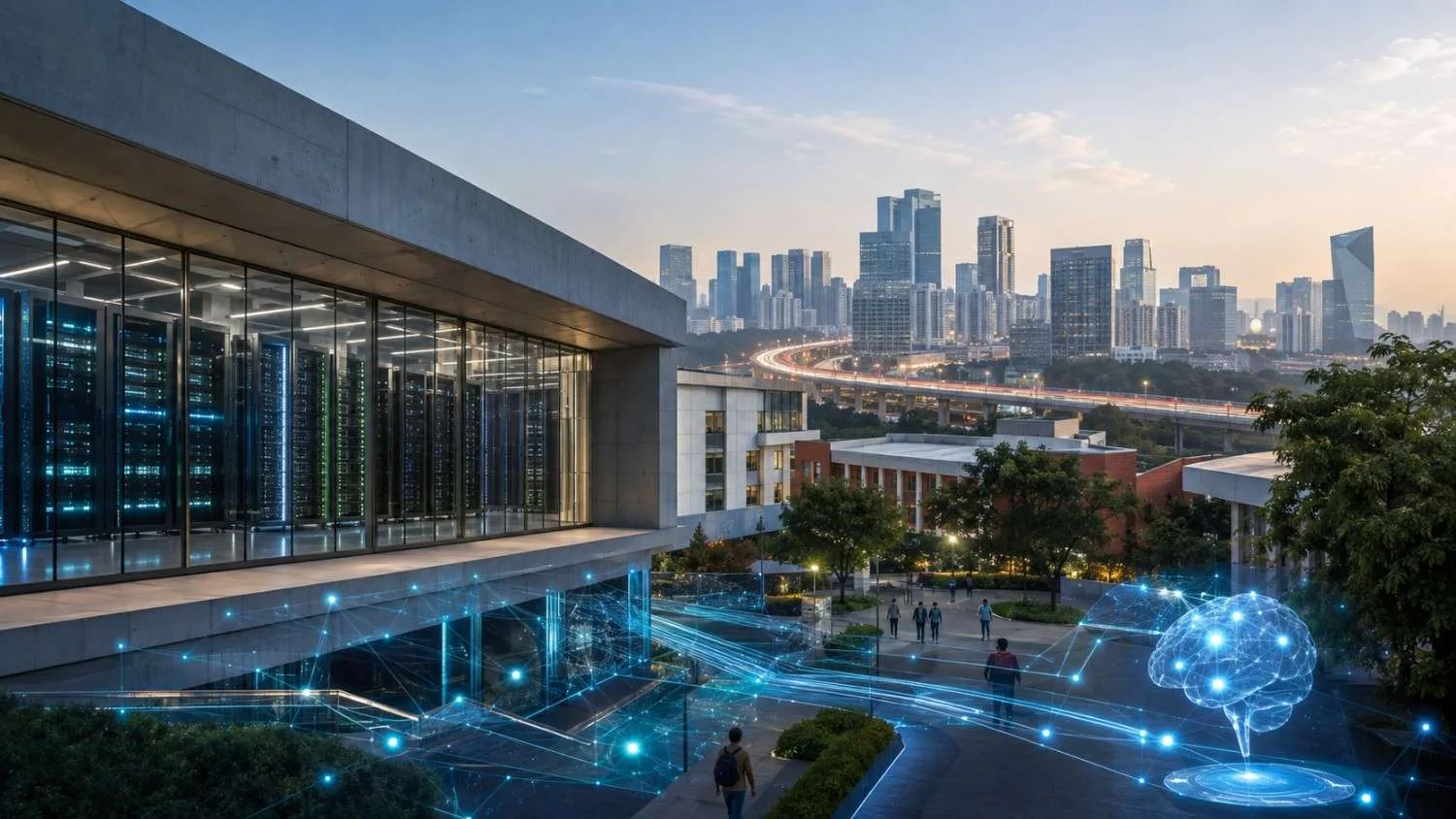
When Prime Minister Narendra Modi inaugurated the Param Pragya AI supercomputing facility at the Indian Institute of Technology Delhi in early 2026, the announcement was framed primarily in terms of India's technology ambitions. But for those who understand how infrastructure investments shape urban development, the question that immediately follows is different: what does concentrated AI computing capacity and research activity mean for the surrounding property market?
The answer is neither simple nor immediate. Large-scale technology infrastructure does not automatically translate into property price spikes. But history shows that sustained research and development activity, particularly when it attracts private sector partnerships, talent migration, and ecosystem development, creates measurable patterns in commercial and residential real estate demand over medium to long timeframes.
This article examines the Param Pragya AI supercomputer Delhi real estate impact with the honesty the topic deserves. We cover what the facility actually is, how similar technology infrastructure has influenced property markets in other locations, what the current state of commercial property near IIT Delhi looks like, and what variables will determine whether this development creates genuine real estate opportunity or remains primarily an academic and research story.
For investors, businesses, and property seekers in Delhi NCR, this is a development worth understanding — not because it guarantees returns, but because it represents the kind of long-cycle infrastructure investment that, if it evolves as intended, could reshape parts of South Delhi's commercial landscape over the coming decade.
What Is the Param Pragya Facility, and Why Does It Matter?
Before discussing real estate implications, understanding the facility itself is essential.
The Technical Basics
Param Pragya is an AI-focused supercomputing facility established at IIT Delhi as part of India's National Supercomputing Mission. The mission, launched jointly by the Department of Science and Technology and the Ministry of Electronics and Information Technology, aims to build domestic supercomputing capacity across research institutions to reduce dependence on foreign computing infrastructure and accelerate India's AI and computational research capabilities.
The facility provides high-performance computing resources specifically optimized for artificial intelligence and machine learning workloads, including:
- Large-scale model training for AI research
- Complex scientific simulations requiring massive parallel processing
- Data-intensive computational tasks across multiple research domains
- Academic and potentially commercial AI development projects
Why Location at IIT Delhi Is Significant
IIT Delhi is not just any research institution. It is:
- India's highest-ranked engineering institution in multiple global rankings
- Located in South Delhi with proximity to government, policy, and corporate decision-makers
- Home to over 8,000 students and 1,200+ faculty members across engineering, sciences, and management
- An active collaborator with Indian and multinational technology companies
- A proven source of startup creation, particularly in technology sectors
Placing advanced AI computing infrastructure at IIT Delhi rather than a remote research campus means the facility sits within an existing ecosystem of talent, industry collaboration, and urban connectivity.
The National AI Infrastructure Context
India's AI infrastructure push is not limited to Param Pragya. The government has been systematically building computational capacity at multiple institutions, creating data center policy frameworks, and encouraging domestic AI development through funding, research grants, and public-private partnerships.
For real estate observers, what matters is not one facility in isolation, but whether this represents the beginning of a sustained concentration of AI-related activity in specific geographic corridors. If IIT Delhi becomes a recognized node in India's AI research and development landscape, the surrounding areas could see demand patterns similar to what occurred around other technology infrastructure concentrations globally and within India.
How Large AI and Tech Infrastructure Investments Have Historically Shaped Property Demand
To understand potential implications, examining historical precedent is more useful than speculation.
The Bengaluru IT Corridor Precedent
When Bengaluru's Electronic City was established in the 1990s and ITPL (International Tech Park) opened in Whitefield in the late 1990s, the immediate impact on surrounding property was modest. It took 3-5 years before residential and commercial real estate in these corridors began seeing sustained demand growth.
What drove the eventual property impact was not the infrastructure itself, but the employment it generated. As Infosys, Wipro, TCS, and dozens of other companies established campuses, tens of thousands of employees needed housing, retail services, schools, and commercial spaces. This created a feedback loop: more employees drove demand for residential property, which attracted retail and hospitality development, which made the area more attractive for additional companies, which brought more employees.
Key lesson: Infrastructure creates property demand indirectly through the employment, services, and ecosystem it attracts, not immediately through its own presence.
Hyderabad IIIT and HITEC City
The International Institute of Information Technology Hyderabad, established in 1998, and the surrounding HITEC City development provide another data point. IIIT Hyderabad's research focus and collaboration with technology companies helped establish the broader Gachibowli-Madhapur corridor as Hyderabad's premier IT hub.
The property impact was not instant. Early investors in Gachibowli property in the late 1990s and early 2000s saw limited immediate returns. But by 2010-2015, as the corridor matured and major global technology firms expanded operations, property appreciation accelerated significantly.
Key lesson: Property impacts from research and technology infrastructure compound over 7-10 year periods as ecosystems mature, not in 1-2 year sprints.
MIT's Kendall Square, Cambridge
Looking internationally, MIT's concentration in Cambridge, Massachusetts, created one of the world's most valuable property corridors—but it took decades. Kendall Square's transformation from an industrial area to a biotechnology and AI hub happened from the 1980s through the 2010s, not overnight.
What made the difference was sustained university-industry collaboration, startup creation, venture capital availability, and deliberate urban planning to make the area attractive to both companies and talent.
Key lesson: Proximity to research institutions creates property value when combined with business ecosystem development, not from academic research alone.
Stanford and Silicon Valley
The classic example remains Stanford University's role in catalyzing Silicon Valley. But Stanford was established in 1885. Silicon Valley's property boom came in the 1970s-2000s. The lag between infrastructure and property impact was measured in decades, driven by continuous startup creation, venture funding, and technology company growth.
Key lesson: Even the strongest precedent shows property impact is a long-cycle phenomenon tied to sustained economic activity, not a short-term infrastructure announcement effect.
South Delhi and IIT Delhi-Adjacent Commercial Property: Current Context
Understanding current supply, demand, and infrastructure around IIT Delhi helps frame realistic expectations.
The IIT Delhi Neighborhood Profile
IIT Delhi's campus is located in Hauz Khas, South Delhi. The surrounding areas include:
Hauz Khas Village: Known for restaurants, cafes, boutiques, and cultural venues rather than commercial office space
Green Park: Mix of residential and small commercial establishments, metro-connected
Safdarjung Enclave and Nearby Areas: Primarily residential with some commercial presence
Outer Ring Road Access: Good road connectivity but not traditionally a major commercial office corridor
Metro Connectivity: The Yellow Line and Magenta Line serve the broader area with multiple stations within 2-3 km of IIT Delhi.
Current Commercial Property Supply Near IIT Delhi
South Delhi's commercial real estate market is fundamentally different from Gurugram's Cyber City or Noida's Sector 62.
Limited Grade-A Office Inventory: South Delhi does not have large commercial office parks comparable to Noida or Gurugram. Commercial space is more fragmented, often in mixed-use buildings or smaller complexes.
High Land Costs: South Delhi land prices are among the highest in NCR, making large-scale commercial development economically challenging compared to Noida or Gurugram where land was cheaper and available in larger parcels.
Regulatory Environment: Development approvals in established South Delhi localities are complex, limiting rapid supply response to potential demand.
Existing Occupier Profile: South Delhi commercial space is occupied by consulting firms, boutique agencies, professional services, small technology companies, and businesses valuing central location over campus-format offices.
What This Means for Near-Term Impact
The Param Pragya facility will not suddenly create thousands of square feet of Grade-A office demand in Hauz Khas next quarter. The immediate demand will be academic—researchers, students, visiting scholars, and academic partners using the facility.
Commercial property impact, if it materializes, will be gradual and tied to:
- Whether the facility attracts sustained private sector AI research collaborations
- If AI-focused startups cluster around IIT Delhi to leverage the computing resources
- Whether consulting firms, AI service companies, or technology businesses choose South Delhi locations to be proximate to IIT Delhi's AI ecosystem
- If residential demand from AI researchers and professionals creates secondary retail and service demand
These are all possible. None are guaranteed. The difference between possibility and reality will play out over years, not months.
What This Could Mean for Office Space, Co-Working, and Residential Interest
Let's map the plausible pathways from AI infrastructure to property demand, acknowledging uncertainty at each step.
Pathway 1: Research Collaboration Driving Office Demand
If the Param Pragya facility attracts significant private sector research partnerships, then participating companies may seek office space near IIT Delhi for research teams working on joint projects.
Variables that affect this:
- Whether government funding and partnership frameworks make IIT collaboration attractive to companies
- If intellectual property frameworks support commercial engagement
- Whether companies prefer co-locating research teams near IIT Delhi or maintaining research at existing Bengaluru/Hyderabad campuses
Property implication if realized: Modest demand for small to mid-size office spaces (5,000-20,000 sq ft) in South Delhi for corporate research teams, potentially supporting co-working space demand rather than full office leases.
Pathway 2: Startup Ecosystem Clustering
If the facility becomes a catalyst for AI-focused startup creation at IIT Delhi, then these startups may cluster in nearby co-working spaces and small offices.
Variables that affect this:
- Availability of venture funding for AI startups in India
- Whether South Delhi develops startup-friendly co-working and accelerator infrastructure
- If founders prefer South Delhi proximity to IIT resources versus established startup ecosystems in Bengaluru, Gurugram, or Noida
Property implication if realized: Increased demand for co-working spaces and flexible office formats within 3-5 km of IIT Delhi, potentially supporting development of tech-oriented co-working facilities.
Pathway 3: Talent Migration and Residential Demand
If the facility attracts leading AI researchers to IIT Delhi as faculty or visiting researchers, then residential demand in South Delhi could see incremental support.
Variables that affect this:
- Scale of talent recruitment: a dozen researchers versus hundreds
- Whether recruited talent prioritizes South Delhi residence versus other NCR locations
- Salary levels and housing budgets of recruited professionals
Property implication if realized: Marginal support for premium residential rental demand in South Delhi localities near IIT Delhi, not a transformational shift in residential pricing.
Pathway 4: Data Center and Tech Infrastructure Spillover
If Param Pragya is part of broader AI infrastructure concentration in Delhi NCR, then data center developers and technology infrastructure companies may increase interest in NCR locations.
Variables that affect this:
- Power availability and pricing for data centers in Delhi NCR
- Land availability for large data center developments
- Regulatory support for data center development in specific NCR zones
Property implication if realized: More likely to impact Greater Noida, Ghaziabad, or Gurugram data center zones than central South Delhi, as data centers require large land parcels and substantial power infrastructure.
Current Delhi NCR Office Space Market, Where Demand Already Exists
Rather than waiting for speculative AI-driven demand, understanding where current commercial demand is concentrated in Delhi NCR provides useful context.
Noida Sector 62 and Expressway Sectors
Noida's Sector 62 and the Expressway corridor (Sectors 125-142) host the strongest technology and corporate office demand in eastern NCR currently.
Why this matters: If AI-related businesses expand in NCR, Noida's established IT corridors with existing technology talent pools, metro connectivity, and Grade-A office inventory are more likely near-term beneficiaries than under-supplied South Delhi.
Featured commercial projects in Noida's proven IT corridor include:
One Estate 62: Grade-A office space in Sector 62 with metro connectivity and an established corporate demand base
Bhutani Cyber Park: Technology-enabled commercial development targeting modern enterprises
Maasters Capitol Avenue: Competitive office space positioning in Sector 62's commercial belt
These represent current, operating office markets with tenant demand today, not speculative future possibilities.
Gurugram Cyber City and Golf Course Road
Gurugram's Cyber City and Golf Course Road corridor remain NCR's premium commercial office market with the highest concentration of multinational technology companies, consulting firms, and financial services.
Why this matters: Established ecosystems with existing talent, service providers, and corporate clusters have gravitational advantages. New AI businesses may default to locating in Gurugram's proven tech corridor rather than pioneering new South Delhi locations.
Ghaziabad and Faridabad Industrial-Commercial Zones
For technology infrastructure and data center development, Ghaziabad and Faridabad's industrial zones offer land availability and power infrastructure that central Delhi cannot match.
Why this matters: If broader AI infrastructure development follows Param Pragya, the heavy infrastructure (data centers, computing facilities, equipment manufacturing) will likely locate in industrial zones with space and power, not in South Delhi's constrained urban fabric.
What Buyers, Investors, and Businesses Should Verify Before Acting on "AI Hub" Narratives
Infrastructure announcements create narratives. Narratives create marketing. Marketing creates claims that may or may not align with reality. Here is what to verify independently.
For Commercial Property Investors
☐ Current occupancy and rental rates in the target locality: Is there actual demand today, or is it speculative?
☐ Historical absorption data: How much commercial space has been leased in the area over the past 24 months?
☐ Competing supply: What other commercial inventory exists in the area and at what vacancy rates?
☐ Tenant profile: Who actually leases space in this micro-market? Technology companies or other sectors?
☐ Rental yield calculations: What is the realistic rental income versus purchase price, independent of appreciation speculation?
☐ Infrastructure delivery timelines: If the investment case depends on promised metro, roads, or other infrastructure, when is actual completion expected?
For Residential Buyers
☐ Employment concentration: Is there actual large-scale employment in the area driving residential demand?
☐ Commute patterns: Where do people working near IIT Delhi actually choose to live currently?
☐ Price benchmarking: How do current asking prices compare to similar properties in established residential corridors?
☐ Developer track record: If buying under construction, what is the builder's delivery history?
☐ RERA compliance: Is the project registered, and what is the complaint history?
For Businesses Considering South Delhi Office Space
☐ Talent availability: Can you recruit the profiles you need if located in South Delhi versus Noida/Gurugram?
☐ Client proximity: Are your clients/partners concentrated in South Delhi or elsewhere in NCR?
☐ Cost comparison: What is the per-seat cost in South Delhi versus Sector 62 Noida or Gurugram?
☐ Infrastructure fit: Does the area have the internet connectivity, power reliability, and supporting services your business needs?
☐ Lease flexibility: Can you scale up or down as needed, or are you locked into long, inflexible commitments?
Red Flags to Watch For
❌ Claims of "guaranteed appreciation" tied to the AI facility announcement
❌ Marketing materials using "next Bengaluru" or "next Silicon Valley" language without evidence
❌ Developers suddenly renaming projects with "AI," "Tech," or "Innovation" branding after the announcement
❌ Off-plan commercial projects being sold to retail investors based solely on proximity to IIT Delhi
❌ Rental yield projections above 8-10% in South Delhi without explaining how that would be achieved
The Long View: What Could Develop Over 5-10 Years
If we step back from immediate speculation and look at what plausibly could happen over a longer horizon, the picture becomes more interesting.
Scenario 1: Research Stays Primarily Academic
The Param Pragya facility serves primarily academic research, with limited commercial spillover. Property impact remains minimal. South Delhi continues its existing trajectory as a mixed residential-commercial area without significant new technology employment concentration.
Probability: Moderate to high, particularly if commercial partnership frameworks remain bureaucratic or intellectual property concerns limit industry engagement.
Scenario 2: Modest Ecosystem Development
The facility attracts 10-20 sustained corporate research partnerships and catalyzes 30-50 AI-focused startups over 5 years. Co-working demand in South Delhi increases modestly. Some small office spaces near IIT Delhi see rental rate premiums of 10-15% versus comparable spaces farther away. Residential rental demand from researchers adds marginal support to the South Delhi premium rental market.
Probability: Moderate, if the government creates enabling partnership frameworks and startup funding for AI continues to grow.
Scenario 3: Significant Cluster Formation
Param Pragya becomes part of a broader Delhi AI corridor with multiple institutions, companies, and startups concentrating AI activity. South Delhi develops 500,000-1 million sq ft of new tech-oriented office and co-working space over 7-10 years. Commercial rental rates in tech-focused buildings near IIT Delhi rise 25-40% over the period. Residential demand from AI professionals creates a measurable impact on rental and sale prices in the 2-3 km radius of IIT Delhi.
Probability: Lower, requires sustained policy support, substantial venture funding, and deliberate real estate development that may face regulatory challenges in South Delhi.
Scenario 4: Broader NCR AI Ecosystem with Diffused Impact
The AI infrastructure push succeeds nationally but does not concentrate in South Delhi. Noida, Gurugram, and Ghaziabad see more AI business development due to better commercial infrastructure, lower costs, and larger talent pools. IIT Delhi becomes a recognized AI research institution, but commercial activity locates elsewhere in NCR. South Delhi property sees minimal direct impact.
Probability: Moderate to high, reflects how previous technology waves concentrated in Noida/Gurugram rather than central Delhi.
How to Explore Relevant Delhi NCR Listings on PropertyGuideOnline
Rather than speculating on future AI-driven demand, investors and businesses can explore current, operating commercial and residential markets across Delhi NCR through verified platforms.
For Commercial Property Seekers
If you are a business considering office space in Delhi NCR to be part of the region's growing technology ecosystem, start with established corridors that have proven demand, not speculative future hubs.
PropertyGuideOnline provides verified commercial property listings across Delhi NCR with a focus on areas with current tenant demand:
- Noida Sector 62: NCR's established IT corridor with metro connectivity and corporate tenant base
- Noida Expressway Sectors: Technology parks and office campuses along Sectors 125-142
- Gurugram Commercial Zones: For those prioritizing Gurugram's established MNC ecosystem
- Ghaziabad and Greater Noida: For businesses seeking value pricing with NCR connectivity
Featured commercial opportunities in Noida's proven corridors:
One Estate 62 offers Grade-A office infrastructure in Noida's most established commercial corridor with current tenant demand, not future speculation.
Bhutani Cyber Park provides technology-ready office space in Sector 62 suitable for AI, software, and technology businesses operating today.
Maasters Capitol Avenue delivers competitive office space positioning in Sector 62 for businesses wanting established IT corridor access without premium pricing.
For Residential Property Seekers
If you are evaluating residential property in Delhi NCR and want proximity to technology employment without paying speculative premiums, focus on areas with current employment concentration:
- Noida Sectors 75-78, 137-144: Residential sectors with good metro connectivity to Sector 62 and Expressway employment zones
- Greater Noida West: Value residential pricing with improving connectivity to Noida's employment centers
- Ghaziabad (Vaishali, Indirapuram): Budget residential options with metro and RRTS connectivity to Delhi and Noida employment
For Investors Seeking Verified Listings
PropertyGuideOnline offers:
✓ Zero brokerage: Direct owner contact eliminating commission costs
✓ Verified badge system: Listings that have been checked for authenticity
✓ Free listing for owners: Focused coverage rather than unfocused national listings
✓ Real-time inquiry tracking: Property owners see views and inquiries as they happen
✓ Commercial and residential coverage: Both asset classes in one platform
Rather than chasing speculative "AI hub" narratives, explore properties with current demand fundamentals at PropertyGuideOnline.com.
Conclusion: Infrastructure Is Interesting, Proven Demand Is Investable
The Param Pragya AI supercomputing facility at IIT Delhi is a genuinely significant development for India's technology ambitions and research capacity. It deserves attention, monitoring, and optimism about its potential to contribute to Delhi's evolution as a technology center.
But for property investors and businesses, the honest assessment is that this is a very early-stage story. Infrastructure does not immediately translate to property demand. Employment concentration, commercial ecosystem development, startup formation, and sustained business activity are what drive property markets, and these develop over years and decades, not quarters.
If you are a business seeking office space today, choose locations with current talent pools, proven connectivity, and existing service ecosystems — places like Noida Sector 62 where projects like One Estate 62, Bhutani Cyber Park, and Maasters Capitol Avenue serve operating technology businesses right now.
If you are a residential buyer, prioritize properties that serve your current commute, family needs, and budget rather than speculating on future AI researcher demand that may or may not materialize at meaningful scale.
If you are an investor, understand that technology infrastructure creates long-cycle opportunities that require patience, monitoring, and willingness to adjust as the story develops. Immediate speculation based on announcement effects typically underperforms patient positioning in markets with current demand fundamentals.
The most valuable real estate opportunities are rarely the ones being loudly marketed based on recent announcements. They are the ones where fundamentals—connectivity, supply-demand balance, regulatory clarity, and proven occupier demand—quietly compound over time.
Explore verified property listings with current demand fundamentals across Delhi NCR at PropertyGuideOnline.com and make decisions based on what is, not what might be.
This article is based on publicly available information about the Param Pragya facility and historical property market patterns. No content constitutes investment advice, guaranteed return projections, or recommendations to buy specific properties. All real estate decisions should be made after independent verification, site visits, legal review, and professional consultation.