Uttar Pradesh Fast Tracks 25,000 Hectares Land Acquisition Near Expressways: What This Means for Commercial Real Estate Investors
Uttar Pradesh is fast-tracking 25,000 hectares of land for 27 industrial and logistics clusters across 14 districts. The move is set to drive demand for commercial property, offices, logistics hubs, and corporate spaces across Noida, Greater Noida, and Ghaziabad. Explore opportunities on PropertyGuideOnline.com.
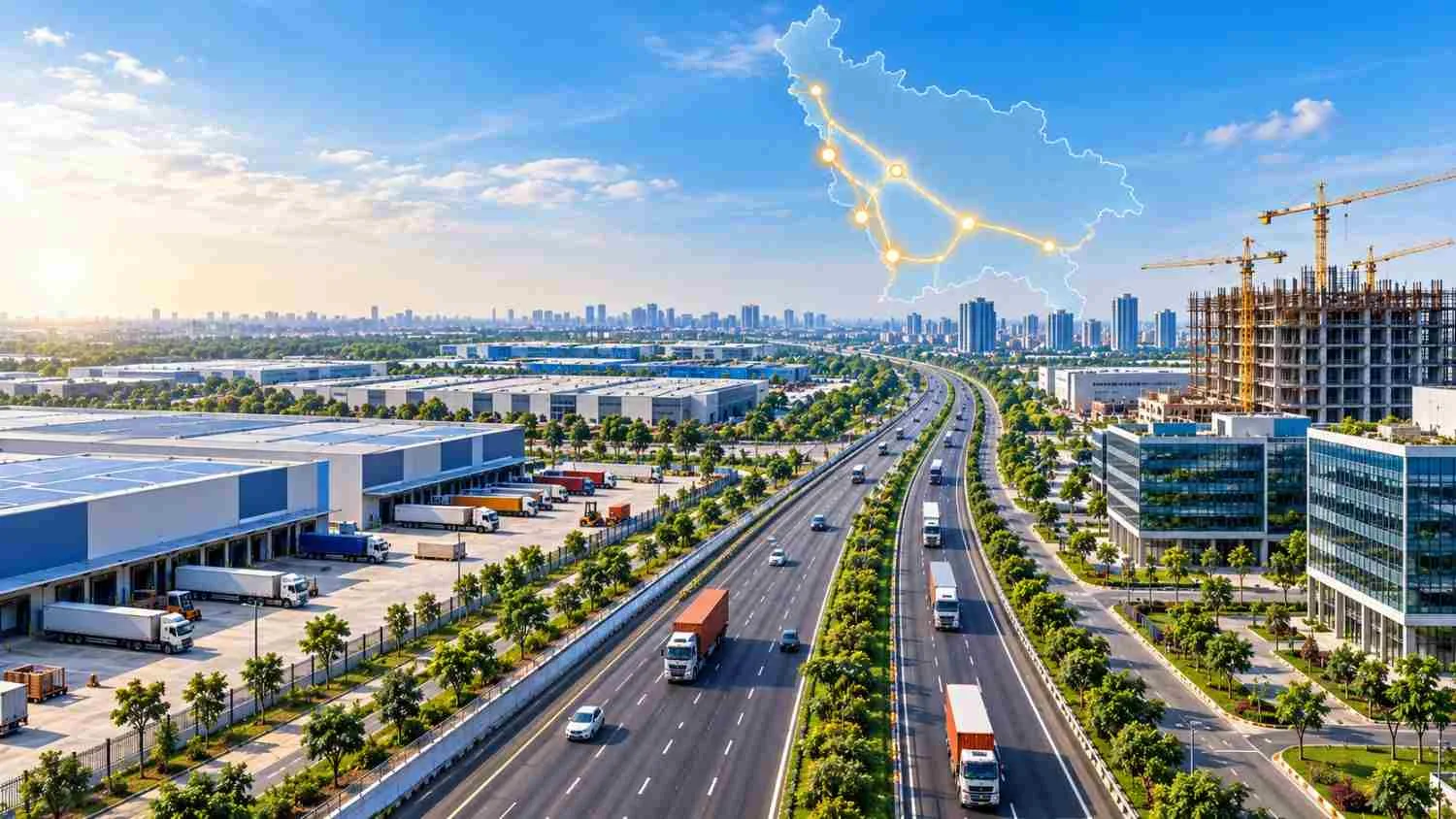
The Uttar Pradesh government has just accelerated one of India's most ambitious industrial land acquisition programs. In September 2026, the state announced it is fast-tracking the acquisition of 25,000 hectares of land along major expressway corridors to develop 27 Industrial Manufacturing and Logistics Clusters across Uttar Pradesh.
This is not a small policy announcement. This is a structural shift in how India's most populous state is positioning itself to capture manufacturing, logistics, and industrial investment over the next decade. For commercial real estate investors, developers, and businesses evaluating where to establish operations in North India, understanding this land acquisition program and what it means for property values, investment opportunities, and infrastructure development is essential.
The UP Expressway Industrial Development Authority, known as UPEIDA, has already identified approximately 5,000 hectares of the total 25,000-hectare target. Of this identified land, more than 4,250 hectares have been acquired as of September 2026. District officials across 14 districts have received direct instructions to expedite the identification and acquisition process under the Industrial Manufacturing and Logistics Clusters blueprint.
This analysis examines what the IMLC framework offers investors, which expressway corridors are being prioritized, how this affects commercial property in NCR cities like Noida and Greater Noida, what investment opportunities are emerging, and how businesses can position themselves ahead of the Groundbreaking Ceremony 5.0 that will launch projects worth an estimated ₹8 trillion.
Understanding the Industrial Manufacturing and Logistics Clusters Framework
The IMLC framework is designed to create plug-and-play industrial infrastructure along UP's expressway network. Unlike traditional industrial areas where businesses must develop their own infrastructure from scratch, IMLCs promise ready infrastructure, including roads, power, water, and connectivity.
The framework offers several advantages for investors. Industrial plots will be available at competitive rates with proactive policy support from the state government. Improved road, rail, and air connectivity is being developed systematically. Skilled manpower development programs are being aligned with cluster needs. Plug-and-play infrastructure eliminates years of setup time.
One particularly interesting aspect is that the framework allows private investors to develop entire industrial parks under the public-private partnership model. This creates opportunities not just for manufacturing companies but for real estate developers and infrastructure investors who want exposure to industrial property development.
The 27 clusters span 14 districts, including Lucknow, Varanasi, Bareilly, Rampur, Sitapur, Mainpuri, Farrukhabad, Bhadohi, Bulandshahar, Mirzapur, Jaunpur, Sonbhadra, Chandauli, and Baghpat. Each cluster is strategically located along one of UP's major expressway corridors to maximize connectivity advantages.
Which Expressways Are Driving the Land Acquisition?
Five major expressway projects form the backbone of this industrial development strategy. Each expressway creates distinct investment corridors with different characteristics.
The Purvanchal Expressway connects Lucknow to Ghazipur in eastern UP, passing through districts that have historically lacked industrial development. The 341-kilometer expressway is now operational and creating new economic corridors in regions that previously had limited manufacturing presence.
The Bundelkhand Expressway links the traditionally underdeveloped Bundelkhand region to the state's economic mainstream. This expressway is one of the largest nodes among the proposed IMLCs. The government sees this corridor as critical to balanced regional development and employment generation in areas that have high out-migration.
The Ganga Expressway, currently under construction, will eventually connect Meerut in western UP to Prayagraj in central UP. This 594-kilometer expressway is positioned as UP's answer to national logistics corridors and will pass through industrial centers, agricultural zones, and cities with existing manufacturing bases.
The Gorakhpur Link Expressway provides connectivity to the Nepal border and eastern UP's commercial centers. For logistics companies targeting cross-border trade with Nepal, this corridor offers strategic positioning.
The Agra-Lucknow Expressway, operational since 2016, has already demonstrated how expressway infrastructure drives industrial and commercial development. The stretch between Noida, Agra, and Lucknow has seen significant warehousing, logistics, and light manufacturing investment over the past eight years.
How This Affects Noida, Greater Noida, and Eastern NCR
While the 27 IMLCs span districts across UP, the implications for NCR cities, including Noida, Greater Noida, and Ghaziabad, are particularly significant.
Bulandshahar and Baghpat, both included in the IMLC framework, sit in the NCR periphery. Industrial development in these districts will create spillover demand for office space, warehousing, and commercial property in nearby Noida and Greater Noida.
The Agra-Lucknow Expressway connects directly to the Yamuna Expressway, which passes through Greater Noida and the Jewar Airport zone. Manufacturing units setting up along the Agra-Lucknow corridor will need supporting offices, logistics hubs, and distribution centers. Many of these supporting facilities will locate in Greater Noida and the Yamuna Expressway belt due to superior connectivity and existing infrastructure.
YEIDA, the Yamuna Expressway Industrial Development Authority, is already seeing increased inquiry from logistics and manufacturing companies that are evaluating sites in the Jewar Airport influence area specifically because of connectivity to the broader UP expressway network.
For commercial property investors in NCR, this creates a thesis: industrial development deeper in UP will generate demand for Grade A office space, logistics parks, and warehousing facilities in NCR's established corridors that offer better talent availability, airport connectivity, and proximity to Delhi's corporate and government decision makers.
Noida Sector 62 and the Expressway sectors are particularly well positioned to capture office demand from companies establishing manufacturing in UP's IMLC zones. Corporate headquarters, regional offices, R&D centers, and sales and marketing operations often locate separately from manufacturing plants. Noida's established IT and corporate infrastructure makes it a natural choice for these functions.
One Estate 62 offers Grade A office space in Noida's premier IT corridor with metro connectivity, positioned to serve companies expanding operations across UP's industrial corridors.
Bhutani Cyber Park provides technology-enabled commercial development in Sector 62 suitable for corporate headquarters and regional offices.
Maasters Capitol Avenue delivers competitive office space in Sector 62's commercial belt for businesses seeking NCR presence alongside UP manufacturing operations.
Groundbreaking Ceremony 5.0: ₹8 Trillion Investment Pipeline
The land acquisition acceleration is happening ahead of the UP government's planned Groundbreaking Ceremony 5.0. This event, where the state launches private investment projects with formal foundation-laying ceremonies, is targeting ₹8 trillion in project announcements.
To put that number in context, at the UP Global Investors Summit in 2023, the state garnered investment proposals worth ₹40 trillion. Through four groundbreaking ceremonies since then, projects worth ₹12 trillion have been formally launched. GBC 5.0 would take the total launched projects to ₹20 trillion, representing half of the total commitments made at the summit.
Invest UP, the state's nodal investment agency, has already compiled a list of projects worth ₹6 trillion for GBC 5.0. The government expects this to expand to ₹8 trillion by the time the ceremony dates are announced.
For commercial real estate investors and developers, these groundbreaking ceremonies are not just ceremonial events. They represent actual project commitments with timelines, land allocations, and implementation roadmaps. Companies that announce projects at GBCs are companies that will need office space, warehousing, worker housing, and supporting commercial infrastructure.
The $1 Trillion Economy Target and What It Means for Real Estate
The Yogi Adityanath government has set a target of achieving a $1 trillion economy for Uttar Pradesh. The IMLC development is explicitly positioned as central to achieving this goal.
Currently, UP's economy is estimated at approximately $240 to $250 billion, making it India's second largest state economy after Maharashtra. Reaching $1 trillion would require quadrupling the economy over the next 10 to 15 years. This is ambitious but not impossible given India's overall growth trajectory and UP's population and resource base.
What makes this relevant for real estate investors is understanding what a $1 trillion economy looks like in physical infrastructure terms. It means tens of millions of square feet of new industrial space. It means massive expansion of warehousing and logistics infrastructure. It means significant growth in office space to house the corporate functions, professional services, and knowledge workers that support a modern industrial economy.
It also means substantial growth in residential real estate to house the workers, managers, engineers, and executives who will staff these facilities. And it means enormous expansion of retail, hospitality, healthcare, and education infrastructure to serve a more prosperous, more employed population.
The real estate implications of UP successfully moving even halfway toward the $1 trillion target are enormous and will be felt most acutely in NCR, where the state's most developed infrastructure and talent pool currently exists.
Flatted Factories: Vertical Industrial Development
One interesting element mentioned in the government's planning is encouraging vertical expansion of industrial units through flatted factories. This represents a departure from traditional horizontal industrial development and signals that the state is thinking seriously about land use efficiency.
Flatted factories are multi-story industrial buildings where different companies occupy different floors. This format is common in countries like Singapore, Hong Kong, and Japan, where land costs are high, but relatively new in India outside of a few projects in Mumbai, Pune, and Bengaluru.
For commercial real estate developers, flatted factory development could represent a new asset class opportunity. The economics differ from traditional office or warehouse development, with different tenant requirements, longer lease terms, and specific infrastructure needs, including heavy-duty elevators, reinforced floors, and substantial power supply.
If UP successfully promotes vertical industrial development, it could free up more land along expressway corridors for complementary commercial uses, including office parks, logistics hubs, and mixed-use commercial developments. This would create additional investment opportunities for real estate developers and investors who specialize in commercial property rather than pure industrial assets.
Investment Opportunities for Different Investor Types
Different types of investors should view this land acquisition program differently based on their capital size, risk tolerance, and investment objectives.
For industrial companies and manufacturers, the IMLC framework offers attractive entry points into UP with reduced infrastructure development time and potentially subsidized land costs. Companies in sectors including automobile components, pharmaceuticals, food processing, textiles, and electronics should be evaluating which clusters align with their supply chain needs.
For logistics and warehousing companies, the expressway corridor locations are purpose-built for distribution center and fulfillment center development. E-commerce companies, third-party logistics providers, and cold chain operators should be tracking which clusters are closest to consumption centers and existing transportation infrastructure.
For commercial real estate developers, opportunities exist in developing supporting infrastructure near the IMLCs, including office parks for corporate headquarters, worker housing projects, retail and hospitality developments, and educational institutions aligned with cluster skill requirements.
For real estate investors, both direct property investment in emerging corridors and indirect exposure through NCR commercial property positioned to serve IMLC-based companies offer different risk-return profiles. Direct investment in IMLC adjacent property offers higher appreciation potential but lower near-term income and longer development timelines. NCR commercial property in established corridors like Noida Sector 62 offers current rental income from existing corporate tenants while benefiting from increased demand as UP's industrial base expands.
PropertyGuideOnline provides verified commercial property listings across Noida, Greater Noida, Ghaziabad, and wider NCR, allowing investors to compare established corridor opportunities with emerging zone positioning.
What Investors Should Verify Before Acting
Land acquisition programs of this scale create both genuine opportunities and speculative narratives that may not materialize. Here is what to verify independently before making investment decisions.
Verify actual land acquisition status by checking with UPEIDA and district authorities directly. Promised land acquisition and completed land acquisition are very different. Focus on clusters where acquisition is substantially complete.
Confirm infrastructure delivery timelines for roads, power, water, and connectivity. Industrial development cannot proceed without these basics. Ask for specific completion timelines, not vague assurances.
Understand the policy incentives clearly, including land pricing, tax holidays, subsidy structures, and approval processes. Get written documentation of what is offered rather than relying on marketing materials.
Research which companies have actually committed to the clusters rather than just expressed interest. Signed land allotment agreements and construction commencement are meaningful indicators. Expressions of interest and MOU signings are less concrete.
Verify your own operational requirements, including workforce availability, raw material access, and market proximity. Not every cluster will suit every business. Choose based on your specific needs rather than general investment promotion.
For commercial property investors, verify that your investment thesis connecting IMLC development to property demand in your target location is sound. Not all NCR commercial corridors will benefit equally. Those with strong connectivity to the expressway network, existing corporate presence, and established infrastructure will capture more spillover demand than peripheral locations.
Conclusion: Position Ahead of the Implementation Wave
Uttar Pradesh's 25,000-hectare land acquisition program is not a proposal. It is happening now. With over 4,250 hectares already acquired and district officials under direct instruction to accelerate identification of the remaining parcels, the IMLC framework is moving from planning to implementation.
For commercial real estate investors, the opportunity is not necessarily in buying agricultural land in remote UP districts hoping it becomes industrial. That carries significant execution risk and timeline uncertainty and requires capital and patience that most investors lack.
The smarter play for most commercial investors is positioning in established NCR corridors that will benefit from UP's industrial expansion without bearing the development risk. Noida's Sector 62, the Expressway sectors, and Greater Noida's commercial zones offer operational infrastructure, current tenant demand, and strategic positioning to capture corporate and logistics spillover from UP's manufacturing growth.
As the Groundbreaking Ceremony 5.0 approaches with ₹8 trillion in project launches, the companies making those investments will need places to put their corporate offices, distribution centers, R&D facilities, and regional headquarters. Many of those facilities will be located in NCR, not deep in UP.
Understanding this dynamic and positioning accordingly is how commercial real estate investors can benefit from UP's industrial ambitions without speculating on undeveloped land parcels in districts with uncertain infrastructure delivery.
Explore verified commercial property opportunities in Noida and NCR at PropertyGuideOnline.com to position yourself ahead of UP's next industrial growth wave.
This article is based on publicly available government announcements, UPEIDA development plans, and UP state policy documents. All investment decisions should be made after independent verification, site visits, legal due diligence, and professional consultation. No content constitutes specific investment recommendations or guaranteed returns.